
State Rep. Ken King (R-Canadian) reviewed the accomplishments of recent legislative sessions when he visited Clarendon last Tuesday for a town hall meeting at the Bairfield Activity Center.
King, who chairs the State Affairs Committee, said the Legislature was faced with about 9,000 bills this year with 700 of them coming through his committee.
“There’s not 700 good ideas in Austin,” King said, “so that’s a really good committee to represent you.”
One of the bills King was particularly proud of was a rural health care bill that provides grant funding for ambulances in rural areas.
“Rural health covers 89 percent of the state,” King said.
Some of his urban colleagues were not strong supporters of the bill, King said, until he asked if they ever traveled to Colorado. He told them if they have an accident on the highway, without support for rural health care, “there’s no one coming to help you.” The bill passed and was signed into law.
Enterprise Photo
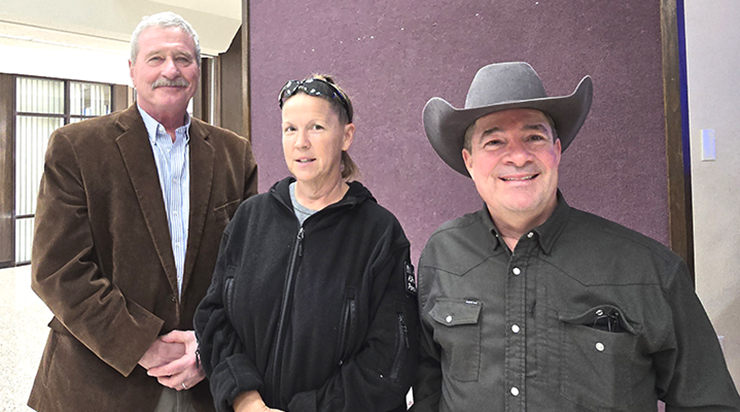
Donley County Judge John Howard and Donley County Hospital District Administrator Anna Howard were both at Tuesday’s meeting to personally thank King for his support of the bill that will allow counties with populations under 10,000 may receive up to $500,000 for new ambulances.
Rep. King also discussed his work to require electric utilities to have wildfire mitigation plans, which will help reduce the likelihood of bad power poles starting wildfires in high winds. In 2024, King said about 80 wildfires were started by electric powerlines. In 2025, King said that number dropped to eight, largely because utilities now deenergize powerlines during high winds.
King also worked to provided $197 million to fund a backlog of grants for equipment for volunteer fire departments. Money has also been allocated to allow the state to secure or contract aircraft for fighting wildfire on its own instead of relying on the federal government.
“During the Smokehouse Creek Fire, we didn’t get planes for four days,” King said.
King wants to continue to work to help first responders and disaster preparedness by addressing issues of interoperability to allow for better and faster communications between agencies.
King also addressed new funding for water projects to prepare the state for the future and discussed carve-outs in that program to make sure rural communities have access to funding. He briefly addressed concerns some citizens have about the water usage of AI datacenters now in development in West Texas and the Panhandle. King said everyone needs to be cautious about calls to restrict water usage.
“The worst thing that can happen is for Austin to start making restrictions on water usage,” he said.
King also said the power production installed by AI datacenters and new nuclear plants will eventually result in a power surplus in the state that will benefit electric rate payers.
King talked about the how the state has used budget surpluses for several things in the last session. He said a lot of that money was still COVID relief money and won’t be coming back, so future state budgets will have to deal with that reality.
He briefly talked about social issues and some of the actions taken by the legislature but also noted that “I’ve never seen us be able to legislate good behavior or morality.”
There were very few questions or comments from the audience on Tuesday. One person asked about school vouchers. King said he doesn’t think the new voucher program will help anyone in his district.
“It’s a billion dollar entitlement that will help less than five percent of the people,” he said.


Leave a Reply
You must be logged in to post a comment.