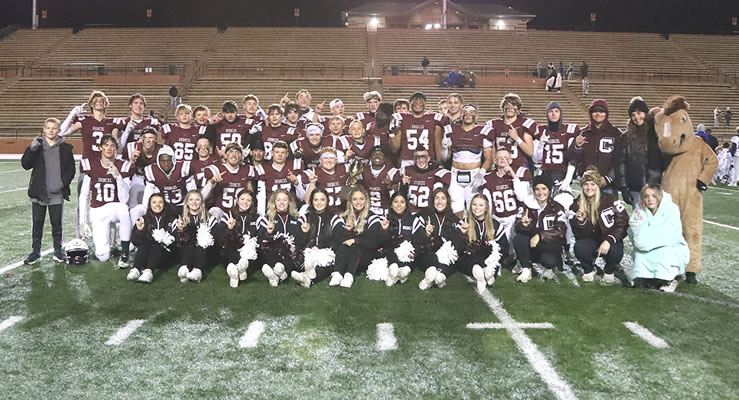
Pee wee teams play Childress

The Clarendon Enterprise - Spreading the word since 1878.


By Sandy Anderberg
Clarendon High School sophomore Madi Benson ran a great cross country race in Lubbock at Mae Simmons Park last weekend.
Benson’s time of 13:05.1 for the two-mile course put her just under 20 seconds behind the first-place finisher. According to coach Korey Conkin, Benson led the field for the first mile and a half of the race. She and fellow athlete Tandie Cummins both received a medal for their efforts in leading the Lady Bronco team to a fourth-place finish in the meet. Cummins ran 12th with a finishing time of 13:41.9.
Gracie Ellis ran 34th in the field of 141 competitors with a time of 14:19.7, and Berkley Moore ran 36th at 14:32.3. Presley Smith was 53rd with a 15:00.8, Kenidee Hayes was 58th at 15:10.9, and Kennadie Cummins ran the course in a time of 16:08.7 finishing in 93rd place.
Bronco junior Bryce Williams had a great race as well and ran a personal best on the Lubbock course with a time of 18:42.2 for 13th place and a medal. Williams was two minutes off the first-place pace in a field of 127 runners. Tanner Cavanaugh also ran and ended the race with a time of 25:33.9.
The Broncos, Lady Broncos, and junior high Lady Colts will participate in the Greenbelt Gallop on October 3 at Greenbelt Lake.
The First Baptist Church of Hedley has called Braden Montgomery as their new pastor.

Montgomery’s first Sunday will be October 1. He grew up in the Panhandle of Texas, going to school in Hedley and graduating from White Deer High School. He has college experience from Wayland Baptist University and has eight years of ministry experience as a youth and music minister. This will be his first pastorate.
Montgomery and his wife, Lauren, have a five-month-old son named Micah. The church is excited about its future and welcomes Braden, Lauren, and Micah with open arms.

Texas Panhandle residents interested in seeing passenger rail service return to the area can make their voices heard with a new Amtrak service study.
The Federal Railroad Administration (FRA) is conducting an Amtrak Daily Long-Distance Service Study to evaluate the restoration of daily long-distance intercity rail passenger service and the potential for new Amtrak long-distance routes.
This study will ultimately create a long-term vision for long-distance passenger rail service and identify capital projects and funding needed to implement that vision.
To add a comment to the study, residents can follow this link and mention their support for adding Amtrak service to Amarillo, Texas: https://bit.ly/4677Eyz.
Supporters of passenger rail service say that it boosts economic development and that it connects rural communities to the nation by providing greater travel opportunities.
According to the FRA website, the Amtrak Daily Long-Distance Service Study will: Evaluate options for restoring or enhancing to daily basis intercity passenger rail service along routes; Select preferred options for restoring or enhancing service; Develop a prioritized inventory of capital projects and other actions required to restore or enhance the service, including cost estimates for those projects and actions; Develop recommendations for methods by which Amtrak could work with local communities and organizations to develop activities and programs to continuously improve public use of intercity passenger rail service along each route; and Identify Federal and non-Federal funding sources required to restore or enhance the service.
Eighty years of passenger train service between Dallas and Denver ended when the Texas Zephyr made its final southbound run coming through Clarendon on September 11, 1967, according to the files of The Donley County Leader. The final northbound run had been made the day before.
The FRA says Amtrak was established by the Rail Passenger Act of 1970, which removed the requirement for US railroads to provide intercity passenger rail service and created Amtrak to fulfill that role instead. In 1971, the US Department of Transportation (US DOT) designated 21 city pairs between which intercity passenger trains should operate, and Amtrak began service between those cities later that year. The new passenger rail system was about half the size (by route miles) of the pre-1971 US passenger rail system, which had been operated by multiple railroads.
In 1975, The Clarendon Press reported that representatives from Clarendon and other area towns addressed hearings in Fort Worth attempting to persuade Amtrak to implement passenger service between Dallas and Denver.
At the request of Congress, several long-distance routes were added to Amtrak’s system in the 1970s, but long-distance service contracted in the following decades – especially after a 1978 US DOT report that recommended significant service reductions, the FRA website reports.
Long-distance network service reductions over the past half century have resulted in some communities losing common carrier transportation options, as well as the economic and social benefits of those connections.


The Camp Cookie wagon team from Germantown, Tennessee, claimed the championship of the Col. Charles Goodnight Chuckwagon Cookoff last Saturday, September 23, beating out 11 other teams.
Competing in the Saints’ Roost Museum’s 28th annual cookoff, Camp Cookie placed first in Overall Cooking and first in Beans, Meats, and Desserts as well as second in Bread to win the title of best Overall Wagon & Cooking.
The Shadow Peak Chuckwagon from Weatherford, Texas., placed first in Wagon & Camp this year in its first appearance at the Clarendon cookoff.
The 16th annual Junior Cookoff the day before the big event drew nine contestants, who were paired with experienced wagon teams to prepare potatoes for the cooks’ dinner Friday night. First was Elika Wilson cooking with Honey Do Spoiler, second was Jase Conway cooking with D Bar B Wagon, and third was Teagan Chesser cooking with Camp Cookie. The Jake Tolbert Memorial Award, a Dutch oven, was presented to Wilson by Vince Smith Solano Wagon Co.
Other junior participants were Kassie Askew from Clarendon, cooking with Crosstimber; Asa Bains from Clarendon, 2M
Chuckwagon; August Pearson from Clarendon, cooking with Shadow Peak; Noah Pearson from Clarendon, cooking with Double Nichols; Elliott Robertson from Clarendon, cooking with Cocklebur Camp; and Henry Robertson from Clarendon, cooking with Wild Cow Ranch
The Junior Cookoff is sponsored each year by the American Chuckwagon Association.
The trade show was held throughout the day Saturday, and live entertainment was provided.
Competing wagons served a menu of chicken fried steak, mashed potatoes, gravy, biscuits, beans, and cobbler. Wagons came from as far as Tennessee and Colorado to attend this year’s cookoff.
Prizes totaling $3,250 were paid out to the winners. Complete results were:
Overall Wagon & Cooking: 1) Camp Cookie.
Overall Cooking: 1) Camp Cookie., 2) Wild Cow Ranch of Fritch., 3) Double Nichols of Amarillo, and 4) D Bar B Chuckwagon of Childress.
Best Wagon & Camp: 1) Shadow Peak, 2) J Bar D Ranch of Amarillo, 3) Crosstimber Ranch of Mustang, Okla., and 4) Wild Cow.
Best Meat: 1) Camp Cookie, 2) D-B, 3) Double Nichols, and 4) Wild Cow.
Best Beans: 1) Camp Cookie, 2) Honey-Do Spoiler of Pampa, 3) Crosstimber, and 4) Solano Wagon Co. of Tucumcari, New Mexico.
Best Potatoes: 1) J Bar D, 2) D Bar B, 3) Wild Cow, and 4) Double Nichols.
Best Bread: 1) Shadow Peak, 2) Camp Cookie, 3) Double Nichols, and 4) Crosstimber.
Best Dessert: 1) Camp Cookie, 2) D Bar B, 3) Wild Cow, and 4) J Bar D.

Dorothy Joy Martin, of Midland, born in Donley County, on October 10, 1928, left this world to
be with the Lord on September 13, 2023.

Dorothy was predeceased by her husband, Ford Martin, her son Mitchell Martin, her grandson Justin Martin, and her sister Jessie Lee Holcomb.
Dorothy leaves behind her son Ricky of Midland, her son Randy of Abilene, sister Carolyn Taylor of Memphis, and brother Jerry Don White of Peoria, Arizona. She also leaves behind numerous grandchildren, great grandchildren, great-great grandchildren, nieces, and nephews, many friends and friends of loved ones that she cared for throughout the years. Dorothy grew up in Lelia Lake. She graduated from Clarendon High School and went to every reunion until she could no longer make the drive from Midland. Dorothy and her husband were residents of Clarendon, along with other members of the Martin family who are laid to rest in the Citizens’ Cemetery of Clarendon.
She worked at the telephone company during World War II along with her husband’s sister Merle Martin who introduced Dorothy to her husband Ford Martin. After leaving Borger, Texas, where she and her family resided for many years, her husband’s work took them to Midland where Dorothy worked for several years at the Odessa Country Club. She even created a Breakfast Mini Muffin Recipe which they still use to this day on their buffet. She then went to work in the safety deposit room at a local bank in Midland which became Chase Bank, and she retired after 25 years of service. She saw the company through many name changes and stayed a dedicated employee throughout all of those transitions. After that, Dorothy went to work for the Yellow Rose Retirement Home. She spent the next 15 years as a cook for the home, taking care of the individual nutritional needs of 8 residents at a time. She worked until they closed their doors. She was 89 years old at that time. She continued cooking for her residents and taking meals to them in their new nursing homes until the last one passed away.
Dorothy dedicated her life to other people, spreading so much joy with her cooking, loving those around her, and giving of herself always. She was so very deeply loved and will be incredibly missed.
She walked this earth as one of God’s angels.
The Family will have a Potluck Dinner and Celebration of Life in Honor of Dorothy at Beall Park Clubhouse 5200 West Wall Street in Midland, Texas, 79703 on Tuesday, October 10, 2023, (her 95th birthday) from 4:30 to 7:30 p.m. Please bring your favorite dish and join the family.
Plans are underway for the 2023 Hedley Cotton Festival to be held Friday and Saturday, October 13 and 14.
Friday night will feature barbecue sandwiches at the Lions Den with chips and drinks. Johnny Woodard will provide music, and everyone is invited to come, stay, and visit.
The Hedley Volunteer Fire Department will get the day started Saturday with a breakfast fundraiser from 7:00 to 9:30 a.m. or until the food runs out. The breakfast will be at the Hedley Senior Citizens building and will cost $9 per person.
The firefighters will also be holding a 50/50 raffle that day. Tickets are available from any firefighter or at Country Bloomers in Clarendon.
The Hedley Senior Citizens will be having a raffle for a Henry Golden Boy .22 rifle and a Henry Lever Action .410. Tickets will be for sale in front of the senior citizens building. The Hedley High School One Act Play will also be having bingo and a silent auction inside the building all day.
The Cotton Festival Kiddie Parade will be held at 11 a.m., and the Festival Parade will be at 1 p.m. For parade entries, contact Mark C. White at 806-277-0412.
The senior citizens will serve hamburgers and chips at noon for lunch, and barbecue sandwiches will also be available again in the Lions Den. All drawings for the festival will be held at 6 p.m. at the Lions Den.
By Kelley Shannon, Freedom of Information Foundation
With trust in government waning, a Texas law can help keep a closer watch on public officials. Even citizens who continue to have faith in government can use this law to stay better informed.

How is taxpayer money spent? What’s happening behind the scenes as government decisions are made?
The Texas Public Information Act produces answers to these crucial questions. The act has been here for us for 50 years and is essential in protecting our right to know.
Like a well-built old house, the landmark law is constantly in need of upkeep, yet it withstands the test of time. It can expose the truth.
At the half-century mark, let’s seize the moment to strengthen the Public Information Act to ensure it works for future generations. The nonprofit Freedom of Information Foundation of Texas will explore this idea at its state conference Sept. 28 in Austin. Discussions will feature transparency advocates, state lawmakers, journalists and everyday Texans from East Texas to Uvalde who have fought for more openness, sometimes in matters of life and death.
The Public Information Act was at issue in a court victory in June to force the release of Texas Department of Public Safety records related to a 2022 mass shooting at Robb Elementary School in Uvalde. The law was also the subject of legislation enacted Sept. 1 to close a loophole some police departments used to hide information when someone dies in law enforcement custody.
Other new legislation to keep the law up to date defines “business day” in the act to prevent government offices from wrongly shutting their doors to information requestors, as many did for months during the COVID-19 pandemic.
Originally known as the Open Records Act when it was enacted in 1973, the Public Information Act is steeped in our state’s history. It came about in a tumultuous time after the Sharpstown scandal in state government. Attorney Bill Aleshire, then a legislative aide for a sponsor of the Open Records Act, recalls helping to write the bill using model legislation from the nonprofit group Common Cause and the best open records ideas from other states.
The Texas law became one of the strongest in the nation. It presumes state and local government records are open – giving citizens a great deal of power in asking for documents, emails, videos and other items – unless a specific exception prevents releasing the information. In most cases, government agencies must ask permission from the Texas Attorney General’s Office to withhold records. The office is supposed to be an unbiased arbiter, with staffers acting as umpires, of sorts, in thousands of rulings every year.
The importance of the agency’s Open Government Division was highlighted in the recent Texas Senate impeachment trial of Attorney General Ken Paxton, who was accused of abusing his power over the public information law. He was acquitted of that charge and all other impeachment counts.
Along with impartial decisions from the attorney general’s office, the Public Information Act needs updated, effective enforcement measures to hold individual government agencies accountable if they are not following the law.
Ideas on how to boost enforcement are plentiful, ranging from imposing financial penalties on misbehaving governments to increasing public officials’ training requirements to ensuring information requestors can recover attorneys’ fees if they must sue to obtain public records.
With the right tools, we can safeguard the intent of the law, which states in its preamble that the people insist on remaining informed.
“The people,” it says, “in delegating authority, do not give their public servants the right to decide what is good for the people to know and what is not good for them to know.”
Kelley Shannon is executive director of the Freedom of Information Foundation of Texas, an Austin-based 501(c)(3) nonprofit dedicated to protecting the public’s right to know and speak out about government.
By Suzanne Bellsnyder, Publisher – Hansford County Reporter-Statesman
Lt. Governor Dan Patrick, as leader of the Texas Senate, conducted a sham trial while claiming to be unbiased in the impeachment hearing of Ken Paxton and had us all fooled.

Immediately following the vote to acquit Paxton on the 16 charges, and from the dais where he presided as the “impartial” Judge in the case, Dan Patrick revealed to Texans his bias immediately with an emboldened speech admonishing the House for their handling of the impeachment.
But in fact, it was in the Senate where corruption was pervasive amongst Paxton, Patrick, and the like. No matter how perfect the case in the House had been, an acquittal was likely in the cards for Paxton. We can look at Patrick’s calculated decisions and clearly see how impeachment was dead on arrival in the Senate.
Patrick could not be an unbiased judge and should have stepped aside. The Rules passed by the Senate allowed Patrick to appoint a jurist to serve as the Court’s presiding officer. Paxton and Patrick have a long history as political allies, and most alarmingly, they are both funded by billionaires Tim Dunn and Wilkes Brothers through the Defend Liberty PAC. The PAC made a $3M combined contribution and forgivable loan to Patrick in June, leading up to the trial. Patrick is not an attorney and has no experience, and this was a critical decision, as Patrick’s bias could not be overcome.
Patrick veiled his intentions by claiming he would do his “duty”, but he made several critical decisions in the trial, which provided an advantage for the defense.
Patrick ruled on the first day that Paxton would not be compelled to testify nor required to attend the trial. This was the first signal of his intention to shield his friend, Paxton, from public scrutiny. A more obvious bias was his tolerance of the ridiculous and ongoing “hearsay” objections made by Paxton’s attorney, Tony Buzbee, which contributed to confusion during the line of questioning around several vital witnesses. It was also revealed following the trial that Patrick had ruled in favor of the defense regarding the admission of critical testimony by Paxton’s mistress. The bribery charges related to the mistress were at the heart of why Paxton was helping his friend Nate Paul, and there was no doubt the mistress’s testimony would be damning to the defense.
And, then, there are the seriously concerning conflicts of interest that were allowed to influence the trial. The impeachment charges were extraordinary in that three Senators and the Lt Governor himself had conflicts of interest related directly to the events involved in this case.
Angela Paxton, of course, as the spouse and a party to some of the bribery charges intertwined through the case, was allowed to participate in the trial as an observer only. The Senate rules removed Senator Paxton from the deliberations. Still, she was allowed to sit on the floor during the entire trial, while Patrick ruled that General Paxton did not need to participate. Senator Paxton’s presence on the floor certainly would have a chilling effect on some of the more sensitive discussions around the mistress and the issues with home renovations, as she had been a direct party to those events.
Two other Senate members, Sen Bryan Hughes and Senator Donna Campbell, also had conflicts of interest. Hughes was the “straw requestor” mentioned in Impeachment Article II, and his name was given during the trial testimony. Paxton’s extramarital affair with Laura Olsen drove the allegation of the bribery charge outlined in Article IX. Olsen had worked in the Senate as a member of Donna Campbell’s staff.
In no other trial would a jury member be allowed to have any involvement in a case and be allowed to sit as part of the jury. Because of these conflicts, these members should have recused themselves from deliberations and voting. But they did not.
The Counting of the Votes
Conflict of interest issues are truly significant because they impacted the fairness of the trial overall, and most importantly, they had a direct impact on the final vote,
The Senators, as the jury, cast their individual votes, and a conviction would have required a 2/3 supermajority vote of the body. It was determined that Mrs./Sen Paxton would not be allowed to vote, but she was included in the total needed to reach the supermajority. With her present “not voting,” the 2/3 threshold was 21; if she had recused herself, the threshold would have been 20. Even more interesting is that if all three Senators with conflicts had “recused”, as they should have, the vote needed would have been only 19.
Republicans Campbell and Hughes both voted to acquit on all 16 charges. Vote counts leaked to the media have said there were 20 votes to convict behind closed doors, but without the 21 being there, some of the fringe voters were afraid to go against Patrick and Paxton.
There are a couple of other events that should cause concern. Since the jury was not sequestered at any time during the trial, they had access to their phone, email, and social media, which meant that they were open to influence. Seven of the Senators, who ultimately voted to acquit, were seen having dinner together in Austin on the evening prior to closing arguments. Patrick confirmed in a post on social media that he “consulted” with two of the jurors on the night before the verdict was voted on after sending the jury home with strict instructions not to talk with anyone.
The biggest miscalculation the House made was to believe that this trail ever had a shot in the Texas Senate. The House pursued impeachment because they were alarmed by the evidence they discovered during the investigation of Paxton’s treatment of the whistleblowers.
Patrick clearly manipulated this solemn, important constitutional process provided by our state constitution and manipulated the proceedings to save Paxton, his political ally, and his donors. He has also used this trial to launch a political war against the House, when, in fact, the House and the Senate are independent bodies by design, to ensure that the interests of Texans are protected.
During the trial, the House attorney Rusty Hardin mistakenly interchanged Patrick and Paxton’s names during the questioning of witnesses. They portrayed Rusty as senile for this, but maybe Rusty was on to something. Patrick and Paxton are one and the same. They are Politicians who will do anything to stay in power. And they did.
Suzanne Sanders Bellsnyder served as a Chief of Staff in the Texas Senate for over a decade. She now lives in the Texas Panhandle and is the editor of the Hansford County Reporter-Statesman, her hometown newspaper, and the Texas Rural Reporter, a statewide news service covering Rural Texas and its interests. Twitter/X: @sbellsnyder | Substack: Texas Rural Reporter

Graveside services will be 11:00 AM Monday, September 18, 2023 in Citizens Cemetery in Clarendon with Chuck Robertson and Thomas Miller, officiating.
Reader Comments