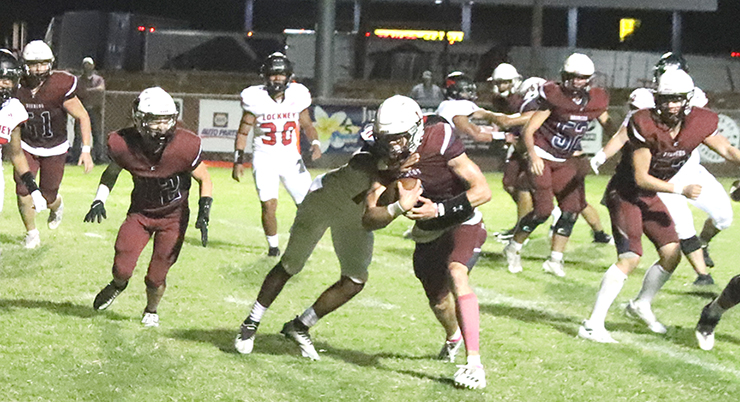
Hedley Owl Kyler Booth gains yards as the Groom defense tries to take him down. The Hedley Owls lost to Groom 51-0 at half last week on the road. Payton Inman was awarded player of the game by Sixmania for Hedley. Enterprise Photo
Donley County Judge John Howard addressed the county’s plans for recently acquired property near the Courthouse Square as the featured program at the Clarendon Lions Club Tuesday.
The county acquired a quarter of a block at the southwest corner of Third and Jefferson across the street west of the county jail about a year ago. Recent demolition of the houses on that property caused a stir on social media which resulted in misinformation being generated.
To set the record straight, he said, the county is not and will not be building a new jail. Howard said the current jail, the original part of which was built in 1981, meets the county’s needs and is “a fortress.” There is no way, Howard said, the county could afford to build a new jail and meet the modern state standards that would be required to do so.
The judge did say, however, that the county is considering construction of a new facility that would house the Donley County Sheriff’s Office and serve as an Emergency Operations Center.
“About ten years ago, I asked the commissioners, “Where are we? What do we have? And where are we going?” Howard said. “We wanted to look to the future and think about what our needs are for years to come.”
Since that time, the county has built a new justice of the peace office in Hedley, a new county barn in Hedley, added on to the county barn in Clarendon, and renovated the Courthouse Annex. Repairs also have been made and proposed facelifts have been discussed for county-owned buildings on the east side of Sully Street north of City Hall.
All of these improvements were made without borrowing money, and the county tax rate is lower than it was ten years ago, Howard said.
Howard said the jail doesn’t have much space for the sheriff’s office, and he noted that dispatchers also serve as jailers, doing two jobs at once. Giving more space to the jailer/dispatchers would require taking in office space used by the sheriff and deputies.
The judge said one that would be good for the county to have is an Emergency Operations Center.
“You don’t have to have it but it would be nice,” he said. “Any event that results in prolonged destruction – like a tornado – or a loss of power or a toxic spill on US 287 or the railroad is going to require more response than what Donley County can provide on its own, and where do you house that?”
Howard said an Emergency Operations Center could be co-located with a new sheriff’s office and could include redundancies in power and communications to remain active during disasters and have workstations available for other emergency officials who would respond from outside the county.
Howard said everything is just the planning and discussion stages right now, but when the county saw an opportunity to purchase property near the jail it moved to buy that in the marketplace. Only one of the homes was occupied, and that renter was given a year’s notice that the county was not going to be in the rental business and that the HUD agreement for that residence would not be renewed.
The properties were purchased for $139,000, and the county paid Grant Construction $24,690 to demolish the houses.
Howard said Commissioner Dan Sawyer is planning to donate gravel to create a parking area, and a carport was left standing for the county’s use.
The Blocker Apartments to the south of the property was not acquired by the county.
The county has no immediate plan to build an Emergency Operations Center, and Howard said Sheriff Butch Blackburn doesn’t have much interest in a new office. Howard federal grant funds could possibly be acquired to help build such a facility. To pursue that option requires working with US Rep. Ronny Jackson’s office and would require the county to get an architect involved and get cost estimates.
Blackburn said he’s not against the idea if there’s grant money to pay for it; but if there’s no grant money, he’s not in favor of asking Donley County taxpayers to pay for it.
If everything were to move forward with a grant application, Howard said federal appropriations wouldn’t happen until fiscal year 2026 or 2027 at the earliest.
State Rep. Ken King will be the lone voice representing truly rural Texas when the next Legislative session starts he told a crowd of citizens and students last Tuesday at Clarendon College’s Bairfield Activity Center.
King said his House District 88 is the last remaining rural district in Texas as it has no single community of more than 100,000 people. The district snakes across Panhandle and down into the South Plains from Hemphill County in the northeast to Andrews County in the southwest.
“My job is to remind everyone that rural Texas Matters,” King said. “Elon Musk can build all the cars he wants in Austin, but without fuel, food, and fiber provided by rural Texas, he can’t exist.”
High on King’s list of things coming up in the next session is education funding.
“There’s nothing more dangerous than an uneducated population,” King said, noting that 75 percent of the state budget goes to public education.
King said the last session of the Legislature saw a “horrible fight” over the voucher plan supported by Governor Greg Abbott.
“Abbott polls 90 percent favorable on border security, and that’s why people keep voting for him,” King said.
When rural Republicans defeated the governor’s school voucher plan, King said Pennsylvania billionaire Jeff Yass, who is invested in TikTok and the private school industry, gave the governor a billion dollars to campaign against those fellow Republicans in the primaries.
“I’m one of the few that survived,” King said. “A lot of the rural Republicans who were good for places like Clarendon College aren’t coming back in the next session.”
King said there will be a voucher system approved in the next session because he will be the only Republican against it. He hopes that after that is in place, the state will start helping public education again.
“We’ve got to quit all the negative and start building up teachers again,” King said. “Texas has done a lot to ruin that profession.”
King also warned of the dangers of social media.
“Please, turn off the Hate Book,” he said. “That thing is just destroying us and spreading misinformation.”
Other upcoming priorities will be further enhancement of border security. He said crossings are dropping, but he also noted that “you don’t have border problems three months before a presidential election.”
“There’s lots of politics going on right now,” he said.
Water will continue to be a big issue in Texas, King said, but his biggest focus outside of public education will be improving the state’s response to wildfires.
“This is an area where policy needs to win over politics because people’s lives and property are at stake,” King said.
King said there will be opportunities for Panhandle representatives to work with hurricane area representatives to improve emergency management measures. He also hopes to get state-owned wildfire-fighting aircraft purchased with at least some of them station in the Panhandle. Currently, the state contracts those services from out of state providers or from the federal government. The process to activate those out of state resources takes days, and there’s not a clear chain of command that takes care of that process.
As always, King encouraged people to vote and said a people who don’t vote get the government they deserve. He also said if Donald Trump wins, it is likely that some state officials – like Gov. Abbott or Attorney General Ken Paxton – may go to Washington to serve in his administration.
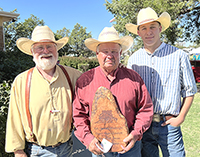
State Rep. Ken King (center) stands with Donley County Attorney Landon Lambert (left) and County Judge John Howard during last Tuesday’s forum at the Bairfield Activity Center. Enterprise Photo
The public has a few more days to complete a survey for the Texas Department of Transportation to provide feedback on the feasibility of upgrading US 287 to interstate highway standards. The original deadline was September 16, but it has now been extended to September 27.
Members of the public are also encouraged to leave comments about specific locations along the corridor on an interactive map. Both the survey and the interactive map will be available through Sept. 27 on https://www.txdot.gov/projects/projects-studies/statewide/us287-corridor-interstate-feasibility-study.html.
Biologists will soon begin conducting white-tailed deer spotlight surveys on rural roads in northern Donley County.
A western route will follow County Road 9 to County Road I, and the eastern survey route will be from County Road 20 to County Road O to County Road 23 to County Road P to County Road 24.
These routes stay on public roads and are run after dark and always in a state truck. Local law enforcement and game wardens are always notified for the safety of the surveyors and the surrounding public. Data gathered from these surveys allows the Texas Parks & Wildlife Department to set bag limits and season dates for white-tailed deer as well as monitor trends in the population.
All surveys should be completed by the end of October.
Communities along US 287 have just a few days left to fill out a state survey about possibly upgrading the highway to interstate standards. The deadline for the survey has been extended to September 27, and the link is at the bottom of this column. If you care about the long-term future of Clarendon and other small towns, you should definitely take five minutes and let the state know your thoughts.
Roger Estlack, Publisher & Editor
Under consideration is a 671-mile stretch of US 287 running from Amarillo to Port Arthur. According to TxDOT, the comprehensive study will evaluate transportation needs and identify potential multimodal solutions to help improve safety and connectivity. The agency wants “to hear from communities, businesses, and the broader public what this corridor should look like and how it can connect communities and foster economic opportunities for Texans for years to come.”
Transportation access is critical to a community’s survival. Clarendon understood that in 1887. When the town learned that the Ft. Worth & Denver Railroad would not being coming through the community’s original location near present-day Greenbelt Lake, the entire town picked up and moved to be on the railroad. Many towns that were missed by the railroad simply disappeared or stagnated.
In the 20th century, what became known as US 287 also was important to the growth and success of Clarendon, providing a steady stream of revenue through the city for decades. Today, about 16,000 vehicles a day travel through town; and while many do not stop, those that do are vital for restaurants, hotels, convenience stores, and other businesses. From an economic development perspective, traffic count is one of the factors that certain businesses look at when considering locating in a community. The higher your traffic count, the more businesses you can attract.
The state is looking at the big picture of US 287. It must consider what is best overall for the state economy and the travelling public. US 287 is one of the busiest thoroughfares in Texas. Upgrading the highway to interstate standards with controlled access would increase the speed and efficiency of goods and people traveling on that road. However, it is safe to say that there is no good way to upgrade US 287 to an interstate through Clarendon – or Memphis or Hedley or Claude or Childress or a host of other small towns. That almost certainly means some form of bypass would be required.
We know what bypasses do to small towns. You can look at Groom and McLean and see what I-40 did for them when it supplanted old Route 66 and went around those little towns. Shamrock seems to have fared better, but there are still a lot of empty buildings that line the old highway.
South of here, US 287 already skips around places like Electra and Iowa Park. In Vernon, US 287 is practically already an interstate; you don’t even have to hit your brakes – just go 75 to 80 mph all the way through town.
For many years, Clarendon has been blessed by three things that keep our town economically stable – Clarendon College, Lake Greenbelt, and US 287. While the college is holding its own, the lake is struggling with the effects of prolonged drought. That makes it more important to hold on to and try to attract more revenue from US 287.
The state’s survey is just eight short questions. Most of it deals with when, how, and why you use US 287 and what concerns you have about the current highway as it is. The eighth and final question is open-ended and allows you to say whatever you want about the highway. The survey also allows you to “place a comment on the study map.” There you can drop a pin on a specific location and make your comment. If you think a place is a safety concern, drop a pin there and make your comment. You can also drop a pin in Clarendon and give your thoughts about the future.
Looking at the comments on the map this week is a little alarming. It appears that someone – or perhaps a bot – is making repeated comments in multiple locations, saying things like, “Please bypass Clarendon,” “Please bypass Memphis,” etc. Other comments are more thoughtful and unique, but many still are either open to or actively encourage bypassing our community. Traffic safety is usually the reason given for that stance.
Everyone’s opinion is valid, and everyone should go make their thoughts known. One thing that should be kept in mind, however, is the significant investment that has been made by existing businesses to locate in Clarendon and similar communities because of the highway. Those investments mean jobs and tax revenue for our towns. Moving the highway would put those businesses at risk and also make it harder to attract new businesses.
Keep in mind that this survey is just the first step in the long-term development of US 287. If the state decided tomorrow that it was going to bypass Clarendon, it would be many years – possibly decades – before it happens. Highway design, environmental impact studies, and right-of-way acquisition takes a lot of time, and then there’s got to be money appropriated. Think about how long we have been hearing about extending I-27 north of Amarillo and south of Lubbock. It’s been 30 years or more, and it still hasn’t happened yet. But it will someday.
Randal “Randy” Lynn Crump, 56, of Clarendon, TX passed away on Sunday, September 1, 2024 in Texola, OK.
Randal “Randy” Lynn Crump
Funeral services are scheduled for 2:30 PM Monday, September 9, 2024, at the Clarendon College Matlock Arena with Joe Neal Shadle, Josey Shadle, Ike Hanes, and Brad Shadle officiating. Burial will follow in Citizens Cemetery in Clarendon.
Arrangements are by Robertson Funeral Directors of Clarendon.
Randal “Randy” Lynn Crump was born on April 12, 1968 to Janie Ivey Gibson and Morris Crump in Memphis, Tx. He graduated from Clarendon High School and went on to attend Clarendon College.
He married the love of his life, Buckie, on June 1, 2014 in Clarendon. They recently celebrated their 10 year anniversary. Randy and Buckie dated in high school, but were reconnected by fate many years later.
Randy worked in Hereford, Tx for Johnny Trotter as the cowboy boss before he moved to Clarendon to start his career at TXDOT. Randy retired from TXDOT in November of 2023 and began working at Bird Electric as a heavy equipment operator and was recently promoted to a safety professional.
Team roping was Randy’s life. He would rope with anyone, anywhere, any time and any age. He was a winner and has many buckles and saddles to show for it, but would give them away in a heartbeat. He enjoyed ranch rodeos, fishing and watching any kind of sport he could get on TV.
In addition to all of his rodeo activities, he loved spending time with his family, especially his grandkids. He was a protector, loving, the best hug giver, a man with the biggest heart, and he loved to tell jokes and stories.
Those left to cherish his memories and honor him are his wife, Buckie Crump; his 6 pack of children, Carissa Crump; Dustin Crump and wife, Jordan; Jacee Crump; Cody Crump and Charlie; Nash Baker and wife, Larissa; Cameron Baker and fiance, Ryder; his mother, Janie Ivey Gibson; his father, Morris Crump and wife, Linda; his brother, Ray Crump and wife, Mike; and his sister, Laura Bailey and husband, Jason.
He greatly cherished his soon to be, 8 grandchildren. Kitana, Vanessa, Wyatt, Kennedy, Eidynn, Tobias, Mercy, and new baby Crump.
He will be greatly missed and remembered by his numerous nephews and nieces, Mike Crump and wife, Julie; Chris Crump and fiance, Rebecca; Avery Bailey, and Ethan Bailey; cousins, friends and his large rodeo family.
The family request memorials be sent to the Dalton O’Gorman Scholarship Fund.
The Clarendon Broncos fought hard against a good Panhandle team last Friday night but were defeated 64-0.
Game stats were not available by press time. The Broncos have been practicing hard under their second year under Coach Aaron Wampler at the helm and knew their pre-District schedule would be tough. They are rebuilding their team after losing several key players last year and are determined to be a contender in the District race.
The Broncos will travel to Sanford-Fritch Friday night, September 6, to take on the Eagles at 7:00.
Mason Sims tries to escape the Panhandle defense last week. Enterprise Photo / Roger Estlack
A Colorado man lost his life in a single vehicle accident near Ashtola Monday afternoon.
According to DPS Sergeant Cindy Barkley, the accident occurred about 4:10 p.m. on US 287, about seven miles northwest of Clarendon.
Samuel Houston, 30, of Basalt, Colo., was driving a 2011 Lincoln MKX SUV south on US 287 when, for an unknown reason, he lost control of the SUV.
The DPS reports said the vehicle traveled off the right edge of the roadway, entered the ditch, struck a road sign, traveled through a barbed wire fence, and rolled over at least two times.
Houston was not wearing a seat belt and, as a result, was ejected during the crash. He was later pronounced deceased on scene by Donley County Justice of the Peace Pat White.
The crash remains under investigation by the Department of Public Safety.
The Clarendon City Council approved its budget for fiscal year 2025 when they met in called session August 22.
The new budget of $2.87 million is just slightly bigger than the current budget of $2.8 million, according to City Administrator Brian Barboza. The new budget will take effect October 1.
Grant projects totaling more than $1.1 million will be a major focus in the new budget, Barboza said. The new budget includes about $135,000 for the city’s grant matches.
A Downtown Revitalization Project in the 200 block of Kearney Street will is a $500,000 project funded mostly by the Texas Department of Agriculture with the city providing about $98,800. Work will include replacement of sidewalks and installing ramping and lighting similar to what was done in the 100 block last year.
The other big project is a new wastewater lift station at Sully and Martindale funded by a federal Community Development Block Grant. The $500,000 project will include a match of $25,000 from the city.
A Texas Department of Transportation RAMP grant will fund most of a $111,000 project to maintain the runway and continue to improve runway lights and other projects at the Smiley Johnson Municipal Airport. The city will provide about $11,000 for that project.
Other takeaways from the new budget include a three percent pay increase for city employees, improvements to the city’s animal shelter, and street maintenance projects.
In other city business, the council selected AW Broadband as the city’s new internet provider. The six-month trail period will be implemented to test out a hybrid fiber and wireless service. The type of service will depend on the location of the service (i.e. City Hall, the recycling center, etc.).
Aldermen also approved an addition to the tenant lease agreements for hangers at the airport to address storage of household items in those facilities.
Contains information related to marketing campaigns of the user. These are shared with Google AdWords / Google Ads when the Google Ads and Google Analytics accounts are linked together.
90 days
__utma
ID used to identify users and sessions
2 years after last activity
__utmt
Used to monitor number of Google Analytics server requests
10 minutes
__utmb
Used to distinguish new sessions and visits. This cookie is set when the GA.js javascript library is loaded and there is no existing __utmb cookie. The cookie is updated every time data is sent to the Google Analytics server.
30 minutes after last activity
__utmc
Used only with old Urchin versions of Google Analytics and not with GA.js. Was used to distinguish between new sessions and visits at the end of a session.
End of session (browser)
__utmz
Contains information about the traffic source or campaign that directed user to the website. The cookie is set when the GA.js javascript is loaded and updated when data is sent to the Google Anaytics server
6 months after last activity
__utmv
Contains custom information set by the web developer via the _setCustomVar method in Google Analytics. This cookie is updated every time new data is sent to the Google Analytics server.
2 years after last activity
__utmx
Used to determine whether a user is included in an A / B or Multivariate test.
18 months
_ga
ID used to identify users
2 years
_gali
Used by Google Analytics to determine which links on a page are being clicked
30 seconds
_ga_
ID used to identify users
2 years
_gid
ID used to identify users for 24 hours after last activity
24 hours
_gat
Used to monitor number of Google Analytics server requests when using Google Tag Manager
1 minute

You can find more information in our Cookie Policy and .
Reader Comments