This Week
Broncos beat Smyer, 64-26

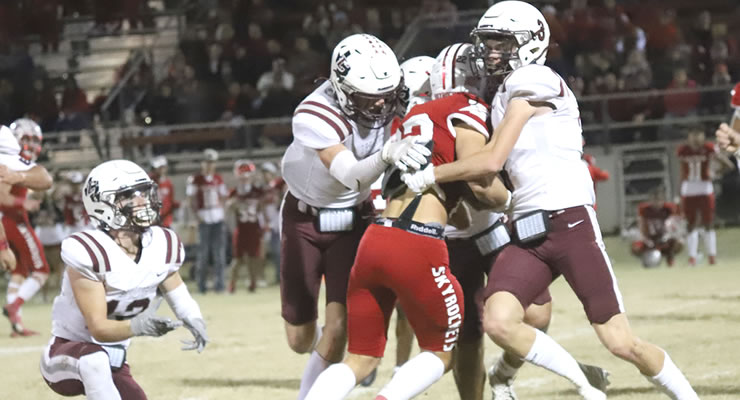
The Clarendon Broncos breezed by Smyer 64-26 in their first win of the season last Friday night before a huge Homecoming crowd. The Broncos racked up over 550 offensive yards and found the endzone 12 times.
Senior running back Lyric Smith’s highlight of the night was a 72-yard kickoff return for six from the Broncos’ 28-yard line. Smith counted for 284 yards on the night with 19 carries for 226 yards in addition to 58yards in the air. He also grabbed five tackles on the defensive side.
Quarterback Harrison Howard was 13 of 20 passing for 226 yards and four strikes. Along with Smith, Howard hit Mason Sims for a 35-yard touchdown and found Easton Frausto and Grant Haynes in the air to account for another two scores. The Bronco offensive line did a good job of opening holes in the Smyer defense to allow the Broncos to rack up 325 yards rushing.
Defensively, the Broncos stopped the Bobcats from gaining any advantage on the field moving the ball. Colton Benson led the team with 13 tackles and Frausto finished with 11. Anthony Ceniceros and Dalton Coles added 10 tackles each. Sims posted five tackles and Haynes finished with four. Heston Seay and Ranger Drenth were in on three tackles each, Kaleb Mays had two, and Hayden Moore, Braylon Rice, Michael Randall had one each.
The Broncos are looking for their second win September 22 at Tulia and preparing for their District opener against Wheeler on October 6.
City okays tax rate, budgets
The Clarendon City Council approved its tax rate and budget for the coming fiscal year during its regular meeting last Thursday, September 15.
Aldermen adopted a tax rate of $0.610083, which is expected to bring in 3.56 percent more revenue to the city. The city budget was also unanimously passed by the council.
The council also considered the Clarendon Economic Development Corporation’s EDC budget and Hotel Occupancy Tax budget and the Clarendon Chamber of Commerce’s Hotel Occupancy Tax budget. Both were approved.
Publicity and Tourism Agreements with the Chamber and CEDC were considered and renewed for a two-year period. The Chamber receives 25 percent of the city’s Hotel Occupancy Tax revenue and the CEDC administers the other 75 percent.
An agreement for consultation services with David Dockery was approved. Dockery is retiring as City Administrator at the end of September but will stay on part time for a limited time as a consultant to help manage projects that are already underway.
The council considered upgrading handrails scheduled for the Downtown Revitalization Project. It’s possible that excess grant funds may be allowed to be used for the handrails. In the event that’s not approved, the city agreed to split the cost of the upgrades with the CEDC.
Paving bids were considered for work being done on the east side of town. Bryers Paving had the low big at just over $87,000. The next lowest bid was close to $113,000.
In public comments, Cindy Cockerham address the board about the health and safety hazard of an abandoned house on the southwest corner of Sims and Third street across from Bronco Stadium.
Museum to hold cookoff Saturday
The Saints’ Roost Museum will hold its 29th annual Col. Charles Goodnight Chuckwagon Cookoff this Saturday, September 23, and its first Shindig Under The Stars on Friday, September 22.
Friday night’s Shindig will feature a dinner at 6:30 p.m. followed by DJ music and dancing at 8:30. Funds raised from this event will benefit the museum’s new Wheels of History building now under construction. The cost of the Shindig is $25. Call 806-874-2746 for information.
On Saturday a dozen chuckwagon teams will compete for top prizes and bragging rights. Tickets for the cookoff are still available at the Donley County State Bank and Every Nook & Cranny. Although admission is free, a $25 meal ticket is required to enjoy the authentic chuckwagon chicken fried steak dinner.
The tradeshow Saturday starts at 10 a.m. Local and area entertainers will also be performing. The authentic wagons will serve at 1 p.m. with the traditional chicken fried steak dinner, and other activities will include a hay auction and the Goodnight family reunion.
Pearson boys adopt the Estlacks

This year the Bronco Parents started a new fundraiser called Adopt a Bronco. It pairs elementary students with high school athletes so older kids can mentor elementary students.
I have been adopted alongside my cousin Daniel by the Pearson family. Last week, we were lucky enough to get to spend some time with them at Stocking’s Ice Cream Parlor and get to know each other a little bit.
My elementary student, August, is a fourth grader. Like me, he enjoys playing tennis and from what I understand he is quite the athlete in the sport. Daniel’s student is a third grader named Noah, and he also likes to play tennis like Dan and I do.
It was fun to meet with the two boys and talk with them about some of their hobbies and interests.
We learned that we all like archery also.
It was great to get to meet with them. They seem like really nice kids, and I am excited to be a mentor to August. Hopefully, we will get to play tennis together sometime.
Pantex, Y12 teams celebrate NNSA awards
Ten outstanding teams were recognized during award celebrations at the Pantex Plant and the Y-12 National Security Complex for the National Nuclear Security Administration (NNSA) Defense Programs (DP) Awards of Excellence.
The winning teams met or exceeded criteria that directly contribute to the sites’ national security mission.
More than 250 Consolidated Nuclear Security employees were involved in the projects that were recognized in the 2021 awards.
At a ceremony to recognize the 2021 winners, Pantex Site Manger Colby Yeary said, “We celebrate the hard work of the men and women who ensure America’s nuclear deterrent provides security to our nation and a warning to our adversaries. We continue to lead by example in our commitment to excellence, and the results we’re seeing in improved performance, deliverables, and innovation speak to the excitement I observe in my colleagues every day.”
At a similar ceremony in Oak Ridge, Tennessee, Y-12 Site Manager Gene Sievers said, “Representatives from Defense Programs select Award of Excellence winners from a large number of applications across the Nuclear Security Enterprise. These folks know the positive impacts of your work, and the awards you’re receiving today are a clear recognition that you are making a difference for our nation.”
Teresa Robbins, NNSA Production Office manager, noted, “Recipients of this award have made notable and significant achievements in providing increased quality, productivity, cost savings, and innovations, that enhance the agility and reliability of our nuclear deterrent.
The Defense Programs Awards of Excellence were established in 1982 to recognize significant individual and team accomplishments in support of NNSA’s nuclear weapons program. An executive review panel meets annually to select the winners.
Marvin Adams, NNSA Deputy Administrator for Defense Programs told recipients, “I am simply amazed at the accomplishments our workforce and the wider enterprise makes each year. Our government leadership, American citizens, the warfighters we support, and our allies can rest confident because of your valuable contributions.”
At Pantex, the winning projects for 2021 were: Completion of the B61-12 LEP First Production Unit ahead of schedule; Implementation of Lightning Detection and Warning System Upgrades that will improve the ability to ensure the safety of production operations; Utilization of Interim Quality Release that saved 64 days of potential production delays; and culmination of a 10-year effort that produced the W88 ALT 370 First Production Unit ahead of schedule.
A multi-site project for which both Y-12 and Pantex received 2021 awards was Gas Mass Spectrometry Coordination that certified the machine to serve as a backup for Y-12 while a commonly used gas mass spectrometer was repaired.
District court hears five Donley County cases
Five Donley County cases were among 29 pleas heard by the district court August 24 when it met in Childress.
District Attorney Luke Inman, along with Assistant District Attorney Harley Caudle, prosecuted the cases for the State of Texas, with the Honorable Judge Ron Enns presiding by assignment.
Jason David Herbert, 47, from Clarendon, was placed on four years probation for the first degree felony offense of possession of a controlled substance in a drug free zone.
Herbert was arrested by Donley County Sheriff’s Deputy Vincent Marasco on May 29 and he pleaded to an information filed by the State on July 12.
Herbert was also ordered to pay a $4,000 fine to Donley County, $340 in court costs, $180 lab fee, and complete 400 hours of community service. If his probation is revoked, Herbert faces up to 99 years or life in the Institutional Division of TDCJ.
Mehgan Matthews, 39, from Iowa Park, was placed on ten years probation for the third degree felony offense of theft of service.
Matthews was arrested by Sheriff Butch Blackburn on March 25, 2021. Matthews was indicted by a Donley County Grand Jury on January 19, 2022.
Matthews was also ordered to pay $290 in court costs, $109,000 in restitution, and complete 200 hours of community service. If her probation is revoked, Matthews faces up to 10 years in the Institutional Division of TDCJ.
Paul Glynn Stewart, 61, from Arlington, was placed on three years probation for the state jail felony offense of possession of a controlled substance in penalty group two, Tetrahydrocannabinol.
Stewart was arrested by DPS Trooper Kelly Hill on September 9, 2022. Stewart was indicted by a Donley County Grand Jury on January 30, 2023.
Stewart was also ordered to pay a $2,500 fine to Donley County, $290 in court costs, $180 restitution, and complete 100 hours of community service. If his probation is revoked, he faces up to two years in the State Jail Division of TDCJ.
Brandon Le Houghton, 29, from Hollister, Calif., was placed on three years probation for the offense of possession of a controlled substance, Tetrahydrocannabinol.
Houghton was arrested by Donley County Sheriff’s Deputy Brian Stevens on June 12. Houghton pleaded to an information filed by the State on June 26.
Houghton was also ordered to pay a $2,500 fine to Donley County, $290 in court costs, $180 restitution, and complete 100 hours of community service. If his probation is revoked, Houghton faces up to two years in the State Jail.
Donna Marie Hendon, 30, from Fort Worth, was placed on three years probation for the state jail felony offense of possession of a controlled substance in penalty group two, Tetrahydrocannabinol.
Hendon was arrested by Stevens on June 4 in Donley County. Hendon pleaded to an information filed by the State on June 16.
Hendon was also ordered to pay a $2,500 fine, $290 in court costs, $180 restitution, and complete 100 hours of community service. If her probation is revoked, Hendon faces up to two years in the State Jail Division of TDCJ.
Opinion: Celebrate, strengthen Public Information Act after 50 years
By Kelley Shannon, Freedom of Information Foundation
With trust in government waning, a Texas law can help keep a closer watch on public officials. Even citizens who continue to have faith in government can use this law to stay better informed.

How is taxpayer money spent? What’s happening behind the scenes as government decisions are made?
The Texas Public Information Act produces answers to these crucial questions. The act has been here for us for 50 years and is essential in protecting our right to know.
Like a well-built old house, the landmark law is constantly in need of upkeep, yet it withstands the test of time. It can expose the truth.
At the half-century mark, let’s seize the moment to strengthen the Public Information Act to ensure it works for future generations. The nonprofit Freedom of Information Foundation of Texas will explore this idea at its state conference Sept. 28 in Austin. Discussions will feature transparency advocates, state lawmakers, journalists and everyday Texans from East Texas to Uvalde who have fought for more openness, sometimes in matters of life and death.
The Public Information Act was at issue in a court victory in June to force the release of Texas Department of Public Safety records related to a 2022 mass shooting at Robb Elementary School in Uvalde. The law was also the subject of legislation enacted Sept. 1 to close a loophole some police departments used to hide information when someone dies in law enforcement custody.
Other new legislation to keep the law up to date defines “business day” in the act to prevent government offices from wrongly shutting their doors to information requestors, as many did for months during the COVID-19 pandemic.
Originally known as the Open Records Act when it was enacted in 1973, the Public Information Act is steeped in our state’s history. It came about in a tumultuous time after the Sharpstown scandal in state government. Attorney Bill Aleshire, then a legislative aide for a sponsor of the Open Records Act, recalls helping to write the bill using model legislation from the nonprofit group Common Cause and the best open records ideas from other states.
The Texas law became one of the strongest in the nation. It presumes state and local government records are open – giving citizens a great deal of power in asking for documents, emails, videos and other items – unless a specific exception prevents releasing the information. In most cases, government agencies must ask permission from the Texas Attorney General’s Office to withhold records. The office is supposed to be an unbiased arbiter, with staffers acting as umpires, of sorts, in thousands of rulings every year.
The importance of the agency’s Open Government Division was highlighted in the recent Texas Senate impeachment trial of Attorney General Ken Paxton, who was accused of abusing his power over the public information law. He was acquitted of that charge and all other impeachment counts.
Along with impartial decisions from the attorney general’s office, the Public Information Act needs updated, effective enforcement measures to hold individual government agencies accountable if they are not following the law.
Ideas on how to boost enforcement are plentiful, ranging from imposing financial penalties on misbehaving governments to increasing public officials’ training requirements to ensuring information requestors can recover attorneys’ fees if they must sue to obtain public records.
With the right tools, we can safeguard the intent of the law, which states in its preamble that the people insist on remaining informed.
“The people,” it says, “in delegating authority, do not give their public servants the right to decide what is good for the people to know and what is not good for them to know.”
Kelley Shannon is executive director of the Freedom of Information Foundation of Texas, an Austin-based 501(c)(3) nonprofit dedicated to protecting the public’s right to know and speak out about government.
Opinion: Patrick shows bias during trial of Paxton
By Suzanne Bellsnyder, Publisher – Hansford County Reporter-Statesman
Lt. Governor Dan Patrick, as leader of the Texas Senate, conducted a sham trial while claiming to be unbiased in the impeachment hearing of Ken Paxton and had us all fooled.

Immediately following the vote to acquit Paxton on the 16 charges, and from the dais where he presided as the “impartial” Judge in the case, Dan Patrick revealed to Texans his bias immediately with an emboldened speech admonishing the House for their handling of the impeachment.
But in fact, it was in the Senate where corruption was pervasive amongst Paxton, Patrick, and the like. No matter how perfect the case in the House had been, an acquittal was likely in the cards for Paxton. We can look at Patrick’s calculated decisions and clearly see how impeachment was dead on arrival in the Senate.
Patrick could not be an unbiased judge and should have stepped aside. The Rules passed by the Senate allowed Patrick to appoint a jurist to serve as the Court’s presiding officer. Paxton and Patrick have a long history as political allies, and most alarmingly, they are both funded by billionaires Tim Dunn and Wilkes Brothers through the Defend Liberty PAC. The PAC made a $3M combined contribution and forgivable loan to Patrick in June, leading up to the trial. Patrick is not an attorney and has no experience, and this was a critical decision, as Patrick’s bias could not be overcome.
Patrick veiled his intentions by claiming he would do his “duty”, but he made several critical decisions in the trial, which provided an advantage for the defense.
Patrick ruled on the first day that Paxton would not be compelled to testify nor required to attend the trial. This was the first signal of his intention to shield his friend, Paxton, from public scrutiny. A more obvious bias was his tolerance of the ridiculous and ongoing “hearsay” objections made by Paxton’s attorney, Tony Buzbee, which contributed to confusion during the line of questioning around several vital witnesses. It was also revealed following the trial that Patrick had ruled in favor of the defense regarding the admission of critical testimony by Paxton’s mistress. The bribery charges related to the mistress were at the heart of why Paxton was helping his friend Nate Paul, and there was no doubt the mistress’s testimony would be damning to the defense.
And, then, there are the seriously concerning conflicts of interest that were allowed to influence the trial. The impeachment charges were extraordinary in that three Senators and the Lt Governor himself had conflicts of interest related directly to the events involved in this case.
Angela Paxton, of course, as the spouse and a party to some of the bribery charges intertwined through the case, was allowed to participate in the trial as an observer only. The Senate rules removed Senator Paxton from the deliberations. Still, she was allowed to sit on the floor during the entire trial, while Patrick ruled that General Paxton did not need to participate. Senator Paxton’s presence on the floor certainly would have a chilling effect on some of the more sensitive discussions around the mistress and the issues with home renovations, as she had been a direct party to those events.
Two other Senate members, Sen Bryan Hughes and Senator Donna Campbell, also had conflicts of interest. Hughes was the “straw requestor” mentioned in Impeachment Article II, and his name was given during the trial testimony. Paxton’s extramarital affair with Laura Olsen drove the allegation of the bribery charge outlined in Article IX. Olsen had worked in the Senate as a member of Donna Campbell’s staff.
In no other trial would a jury member be allowed to have any involvement in a case and be allowed to sit as part of the jury. Because of these conflicts, these members should have recused themselves from deliberations and voting. But they did not.
The Counting of the Votes
Conflict of interest issues are truly significant because they impacted the fairness of the trial overall, and most importantly, they had a direct impact on the final vote,
The Senators, as the jury, cast their individual votes, and a conviction would have required a 2/3 supermajority vote of the body. It was determined that Mrs./Sen Paxton would not be allowed to vote, but she was included in the total needed to reach the supermajority. With her present “not voting,” the 2/3 threshold was 21; if she had recused herself, the threshold would have been 20. Even more interesting is that if all three Senators with conflicts had “recused”, as they should have, the vote needed would have been only 19.
Republicans Campbell and Hughes both voted to acquit on all 16 charges. Vote counts leaked to the media have said there were 20 votes to convict behind closed doors, but without the 21 being there, some of the fringe voters were afraid to go against Patrick and Paxton.
There are a couple of other events that should cause concern. Since the jury was not sequestered at any time during the trial, they had access to their phone, email, and social media, which meant that they were open to influence. Seven of the Senators, who ultimately voted to acquit, were seen having dinner together in Austin on the evening prior to closing arguments. Patrick confirmed in a post on social media that he “consulted” with two of the jurors on the night before the verdict was voted on after sending the jury home with strict instructions not to talk with anyone.
The biggest miscalculation the House made was to believe that this trail ever had a shot in the Texas Senate. The House pursued impeachment because they were alarmed by the evidence they discovered during the investigation of Paxton’s treatment of the whistleblowers.
Patrick clearly manipulated this solemn, important constitutional process provided by our state constitution and manipulated the proceedings to save Paxton, his political ally, and his donors. He has also used this trial to launch a political war against the House, when, in fact, the House and the Senate are independent bodies by design, to ensure that the interests of Texans are protected.
During the trial, the House attorney Rusty Hardin mistakenly interchanged Patrick and Paxton’s names during the questioning of witnesses. They portrayed Rusty as senile for this, but maybe Rusty was on to something. Patrick and Paxton are one and the same. They are Politicians who will do anything to stay in power. And they did.
Suzanne Sanders Bellsnyder served as a Chief of Staff in the Texas Senate for over a decade. She now lives in the Texas Panhandle and is the editor of the Hansford County Reporter-Statesman, her hometown newspaper, and the Texas Rural Reporter, a statewide news service covering Rural Texas and its interests. Twitter/X: @sbellsnyder | Substack: Texas Rural Reporter
Edna Jewell Durbin

Graveside services will be 11:00 AM Monday, September 18, 2023 in Citizens Cemetery in Clarendon with Chuck Robertson and Thomas Miller, officiating.

Reader Comments